Lessons From the Wilderness
- Melissa Collins
- Jun 23, 2025
- 15 min read

Bamidbar | במדבר | "In The Wilderness"
Torah: Numbers 1:1 - 4:20
Prophets: Hosea 2:1-22 (1:10 - 2:20)
Brit Hadasha: Luke 16:1 - 17:10; 1 Corinthians 12:12-31
🕊 “Counted, Called, and Camped: Lessons from the Wilderness”
🪧 INTRODUCTION
We begin a new book of the Torah this week — Bamidbar, known in English as “Numbers.”
But the Hebrew name — Bamidbar — means “In the Wilderness.”
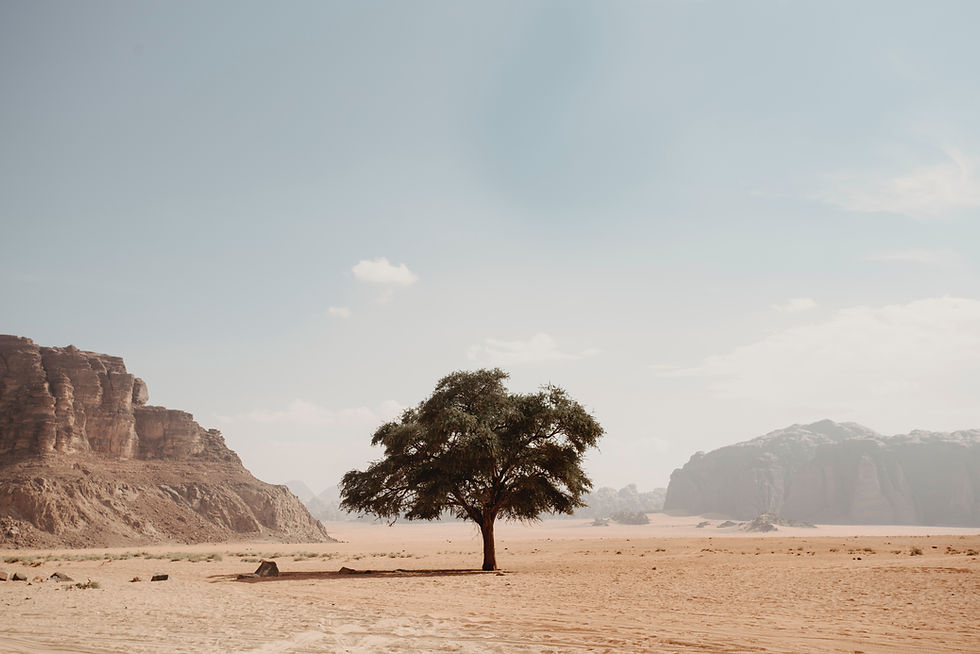
In Hebrew, the word “midbar” (מִדְבָּר) — wilderness — comes from the root “davar”, meaning to speak. The wilderness isn’t just a place of silence — it’s where God speaks.
I believe that shift in language (Numbers from Wilderness) is more than just semantics; it’s a shift in perspective. The world sees the wilderness as barren and harsh — a place of punishment. But Yahweh uses the wilderness as a place of preparation, intimacy, and restoration.
“Therefore, behold, I will allure her, bring her into the wilderness and speak kindly to her…”— Hosea 2:14
🌾 POINT 1: The Wilderness — A Place of Intimacy
Torah: Numbers 1:1
"Yahweh spoke to Moses in the wilderness of Sinai..."
This isn’t just a geographical note. It’s deeply symbolic.
The wilderness is the place Yahweh chooses to speak to His people — not in the noise of Egypt, not in the distractions of Canaan — but in the stillness of the desert.
In Hosea 2, Yahweh allures His unfaithful bride into the wilderness — not to destroy her — but to woo her again.
Sometimes the hard places are the holy places.
There are a lot of examples in the bible where we see God’s people in the wilderness. The first one that come to mind is of course Jesus in the wilderness. But Moses also spent a lot of time in the wilderness. The children of Israel were 40 years in the wilderness.
And like we talked last week, it isn’t necessarily a place of punishment. It’s a place of mercy. Yes, the children of Isreal went from only a couple of years in the wilderness, to ooops, now it’s 40 years. But…. In the same way we discipline our own children, we don’t discipline out of hate or condemnation. We discipline to teach, and to make them better people.
If we never disciplined our children at home and then turned them out as adults into this cruel world, we have set them up for failure. And I beg the question; did you really love them?
Yahweh chastise those He loves. (Hebrews 12:6) And this extra time in the wilderness, an opportunity to woo, and mold, and learn and strengthen.
It is those hard places, often when you feel alone, when you feel He isn't there, when you don't know how you are going to survive, but you do. Because He is there. He provides. He makes a way. He feeds us. He goes before us. He goes behind us.
It's here where we are romanced. Where the real growth of the relationship happens. Where we learn His nature and His character. It's where our faith is strengthened.
Not in front of crowds.
Moses had to see the staff turn into snakes first in the wilderness, then in front of the crowds.
God is merciful like that. He doesn't throw us onto a stage at a packed football stadium, before we have tested our relationship with Him first in the wilderness of a prayer closet. Not just testing us, (where will we turn, or who will we trust) but also in a way Him proving Himself. How would we "know" that we trusted Him if nothing was ever hard?
How do you know a life jacket will save you if you never get it in the water? You only suspect it will. God isn’t asking us for suspicion. He is better than that. He is asking us to trust Him, to rely on Him. But we’ve got to get in the water.
It’s just like building muscles requires exercise. How can we have strong faith if we never have to stretch those muscles? Strength comes from hours in a gym. Not just a few minutes here & there in passing. But the daily grind. It takes an investment of time and it takes work and heavy lifting. And that time and work = strength.
Deuteronomy 8:2: "And you shall remember the whole way that the Lord your God has led you these forty years in the wilderness, that he might humble you, testing you to know what was in your heart, whether you would keep his commandments or not".
Faith works exactly the same way. It requires time and effort. And sometimes that hurts. But it is the stretching of those faith muscles that increases the strength of our faith.
Hebrews 12:11: "For the moment all discipline seems painful rather than pleasant, but later it yields the peaceful fruit of righteousness to those who have been trained by it".
Think about a paraplegic. What happens to them? When they don't use their muscles, they waste away. Are we using our muscles? Or are we sedentary in our faith?
I say this a lot, and I’m sure you’ll hear me say it again, but God is such a gentlemen. You never show your intimate moments with our spouse in public. That’s indecent and rude. Again, these places of getting to know each other intimately won’t happen in a public forum, it takes place in those private moments, in those hard moments, in the wilderness of life.
It’s not the palace, the stage, or the sanctuary where the deepest intimacy is formed — it’s in the dry, empty places. The places where only He can sustain you. The places where there's no applause, no spotlight, no backup plan.
6 Wilderness Examples
🔥 1. Jesus Was Led into the Wilderness
"Then Jesus was led up by the Spirit into the wilderness to be tempted by the devil."— Matthew 4:1
· Not led by Satan — led by the Spirit.
· This was right after His baptism — before He preached, healed, or taught.
· He spent 40 days fasting, alone, battling the enemy with nothing but the Word.
o Can we fast before Shavuot?
· And when He came out of the wilderness? “Jesus returned in the power of the Spirit” (Luke 4:14).
o The wilderness was preparation, testing, and empowerment.
🧎🏽 2. Moses Met God in the Wilderness
"Now Moses was tending the flock of Jethro… and he led the flock to the far side of the wilderness and came to Horeb, the mountain of God."— Exodus 3:1
Before Moses led Israel, he was alone in the wilderness, tending sheep.
It was here, in obscurity and isolation, that the burning bush appeared.
It was here that Moses argued with God, doubted himself — and still, God called him by name, revealed His personal name YHWH, and gave him the signs he would need.
Moses had to see the staff turn to a snake in private before he ever did it before Pharaoh.
God prepares us in private before He reveals us in public.
🌾 3. The Children of Israel Were Transformed in the Wilderness
"Who led you through the great and terrible wilderness… to humble you and test you, to do you good in the end."— Deuteronomy 8:15–16
40 years of wandering wasn't just judgment — it was refining.
Manna fell from heaven (Exodus 16), water came from rocks (Exodus 17), and clothes didn’t wear out (Deuteronomy 8:4).
The wilderness was where God said:
“I carried you, as a man carries his son.” (Deut. 1:31)
It’s where He fed them, He protected them, He dwelled among them.
It’s where He gave the Law, the Tabernacle, and the priesthood.
💔 4. Hosea — The Unfaithful Bride Allured Back
“Therefore, behold, I will allure her, and bring her into the wilderness, and speak tenderly to her.”— Hosea 2:14
The wilderness is where Yahweh romances the soul.
He doesn’t take the unfaithful bride to court — He takes her to the quiet place.
He doesn’t scold her in front of the nations — He brings her alone, where He can speak tenderly and renew the covenant of love.
🧠 5. The Wilderness Trains Our Faith Muscles
“Count it all joy when you fall into various trials, knowing that the testing of your faith produces endurance.”— James 1:2-3
We want mountain-top faith, but often we don’t want wilderness workouts.
Faith isn’t built in comfort — it’s built in crisis.
Muscles unused waste away.
Some of us have spiritually paralyzed faith because we’ve avoided wilderness training.
“Though He slay me, yet will I trust Him.” — Job 13:15
Ask Yourself:
Are you exercising your faith?
Or are you spiritually sedentary, waiting for signs before trusting?
🙏🏽 6. Elijah in the Wilderness
“And he arose and ran for his life… and came and sat under a broom tree. And he asked that he might die...”— 1 Kings 19:3–4
I know we have all been there.
Elijah, even after a great victory, fled to the wilderness depressed and afraid.
What did God do? He let him sleep. He fed him. Then He brought him to Mount Horeb, and spoke — not in fire or earthquake, but in a still small voice.
The wilderness is where God ministers to the soul — physically, emotionally, and spiritually.
Challenge to the Flesh:
Are you willing to be led into the wilderness so Yahweh can strip away the idols and romance your soul?
· In the crowd, you may be applauded — but in the wilderness, you are known.
o Matthew 7:21-23 21 “Not everyone who says to me, ‘Lord, Lord,’ will enter the kingdom of heaven, but the one who does the will of my Father who is in heaven. 22 On that day many will say to me, ‘Lord, Lord, did we not prophesy in your name, and cast out demons in your name, and do many mighty works in your name?’ 23 And then will I declare to them, ‘I never knew you; depart from me, you workers of lawlessness.’
· It’s the prayer closet, the night watch, the tears on your pillow, the Bible pages worn by wrestling. It’s where you learn His voice, His character, His provision, and your purpose.
o “He knows the way that I take; when He has tested me, I will come forth as gold.” — Job 23:10
Sukkot This also leads us to Sukkot. Lev 23:33-34 33 And the Lord spoke to Moses, saying, 34 “Speak to the people of Israel, saying, On the fifteenth day of this seventh month and for seven days is the Feast of Booths[f] to the Lord.
23: 41 You shall celebrate it as a feast to the Lord for seven days in the year. It is a statute forever throughout your generations; you shall celebrate it in the seventh month. 42 You shall dwell in booths for seven days. All native Israelites shall dwell in booths, 43 that your generations may know that I made the people of Israel dwell in booths when I brought them out of the land of Egypt: I am the Lord your God.”
Before we leave here today, I want to have an “in tents” conversation, about our planned wilderness time in Sukkot. 🏕️
🏕 POINT 2: Camped with Purpose — Belonging, Identity, Direction
Numbers 2 gives a map of where each tribe camped around the Tabernacle, but before that they were counted.
That’s such a strange phrase to us: “the number of their names. "Why not just say "a headcount"? Why not say "total men eligible for war"?
Because this wasn’t just about counting bodies — this was about identifying individuals. Every name written. Every person known. Every tribe represented. Every soul counted.
It reminds me of how Yahweh sees us.
“He calls His own sheep by name.” — John 10:3“Even the hairs on your head are numbered.” — Luke 12:7“Those whose names are written in the Lamb’s Book of Life.” — Revelation 21:27
But here’s what got me this week — while Yahweh numbers His own by name, we are warned in the Book of Revelation that the enemy also uses numbers and names:
“Let him who has understanding calculate the number of the beast, for it is the number of a man: his number is 666.” — Revelation 13:18
Don’t miss this: There are two kinds of people — those who are counted by name, and those who are reduced to a number.
God calls you by name, and seals it. The enemy gives you a mark.
God gives you an identity. The enemy strips it away.
God says you belong. The enemy says you comply.
🏳️ Belonging, Banners, and Tribal Identity
In Numbers 2, we see that each tribe didn’t just get counted. They were assigned a place around the Tabernacle. They were grouped in families, by clans, and told to camp beneath their banner.
“Each man of the people of Israel shall camp by his own standard, with the banners of their fathers' houses.” — Numbers 2:2
These weren’t just decorations. These were prophetic emblems. Each tribe’s banner held meaning — colors, animals, symbols. Judah had the lion. Ephraim, the ox. Reuben, a man. Dan, the eagle. Does that sound familiar?
“And around the throne… were four living creatures…” — Revelation 4:6–8
The tribal banners were a foretaste of heaven’s courtroom. But flags are even so much more….
A flag is a visual marker of their identity, function, and direction. Flags identify you. Flags unify you. Flags direct you. Flags even command a reaction.
We all know this:
A green flag says, “Go.”
A red flag says, “Stop.”
A yellow flag says, “Caution.”
A checkered flag says, “Finish line.”
A flag at half-mast says, “We mourn.”
A waving flag in front of a construction crew says, “Proceed carefully — danger up ahead.”
Flags communicate who you are, what you’re doing, and how you should respond.
And I believe with all my heart — Yahweh is raising banners again. Not of a nation. Not of a denomination.But of identity. Of those who are His.
“He brought me to the banqueting table, and His banner over me was love.” — Song of Songs 2:4
"In that day the Root of Jesse will stand as a banner for the peoples; the nations will rally to Him, and His resting place will be glorious." (Isaiah 11:10)
👥 From the Individual to the Whole
We are counted by name, but we are camped by tribe, and we are known as Israel.
That’s three levels of belonging:
Individual identity – You are not a number. You are a name.
Tribal function – You have a role to play. You’re not just saved — you’re assigned.
National purpose – Together, we form the body. One people. One camp. One mission.
That’s how the body of Messiah is supposed to work, too:
“The body is one and has many members… If the whole body were an eye, where would the hearing be?” — 1 Corinthians 12:12–20
The Levites camped closest to the Tabernacle, surrounding it on all sides, reflecting their roles as servants, guardians, and worship leaders. Also foreshadowing that the gospel would be preached to all four corners of the earth.
Judah camped on the east — the side of the rising sun — and was the first to break camp. Because light comes from the East, that is where Moses, Aaron, and his sons camp, since they are great, holy men responsible for carrying the light of God to the nation.
Matthew 24:27 For as the lightning flashes in the east and shines to the west, so it will be when the Son of Man comes.
Look at the tribes on the west. Are these not the tribes that scholars suspect are the western believers today? Coincidence? Probably not.
Are you seeking to be numbered among those called by His name, or those who follow the beast for convenience and comfort?
One side is easy. You get a mark and you can buy and sell no problem. No rules.
The other side is uncomfortable, but you are called. You trust in Him for manna, not in man.
And once again, we are looking at choices. The choices we are making today, are setting us up to determine the choice we will make in the future. Sealed with God, or marked by the beast?
🧮 POINT 4: The Season of Counting
One of my favorite things about studying the Torah is how we begin to see and understand God’s character. One thing we can already tell is that God is a God of order, of cycles, of heartbeats and rhythms. God is in the business of rhythms, not randomness. When He counts, He counts for purpose.
Right now, we’re in the middle of a season of counting. It’s called Sefirat HaOmer — the counting of the Omer. We’re counting 49 days from Passover to Shavuot.
Leviticus 23: 15 “‘From the day after the Sabbath, the day you brought the sheaf of the wave offering, count off seven full weeks. 16 Count off fifty days up to the day after the seventh Sabbath, and then present an offering of new grain to the Lord.
Every day is intentional. Every day builds anticipation.
Think about the days you count down to. As a child, I counted down to Christmas. I’d even make little paper chains to count down the days. Then I’d count down to my birthdays. People count down to vacations. “How many more sleeps until Disney World?”
In that same anticipation, we are counting down to the feast of Pentecost or Shavuot!!!!! Which I’ll talk so much more about next week. But did you notice anything in this week’s reading?
The same pattern appears when we count for the Year of Jubilee.
· 7 weeks of days = 49 days → then the 50th = Shavuot -The Counting of the Omer (between Passover and Shavuot)
· 7 cycles of 7 years = 49 years → then the 50th = Jubilee
o Genesis 6:3 3 Then the Lord said, “My Spirit will not contend with[a] humans forever, for they are mortal[b]; their days will be a hundred and twenty years.”
We are counting down to Shavuot! We are counting down to Revelation! We are counting down to Jesus’s return!
We may have lost count…. I don’t want to be date setting. As you know, time may be cut short. But some scholars believe that the 120th final jubilee will be in 2044. Some believe that we are already in that last 50 years, that began in 2015. All scholars seem to agree that we are very close.
This is the final countdown.
Both countdowns lead to freedom. So as we finish up these last days counting down to Shavout, let us count down to prepare, and count on something holy.
Closing:
If you’re feeling lost, you may actually be right where God wants to meet you.
The wilderness is where idols die, manna falls, and the Word is spoken.
He’s not punishing you. He’s wooing you.
He knows your name. You have a banner. You belong in the camp.
Prayer
The Way
Usually there is a common theme between the Parasha and the corresponding Haftarah (prophetic portion).
The connection in today’s study from the Book of Hosea (Hosea 1:10–2:20 [2:1–2:22]) is the wilderness and the numbering of the people of Israel.
Hosea, in fact, prophesies that Israel’s population will grow in number like the sand of the sea. Hosea prophesies that the two houses of Judah and Israel will eventually be re-unified in the Messianic Era under a single leader, as also foreseen by Daniel, Isaiah, Ezekiel, and Zechariah, among other prophets and writers. (Daniel 7:13–14; Isaiah 9:6–7, 11:1–16; Ezekiel 37:15–28; Zechariah 14)
This leader is Yeshua HaMashiach (Jesus the Messiah).
“And the children of Judah and the children of Israel shall be gathered together, and they shall appoint for themselves one head. And they shall go up from the land, for great shall be the day of Jezreel.” (Hosea 1:11 [2:2], also 3:3–5)
Because of this theme of assembling together in unity under one head, this portion is read before Shavuot, the time when according to tradition all the children came as one people to receive the Torah at Mount Sinai.
Likewise, at Shavuot (also known as Pentecost), the disciples of Yeshua waited in unity of mind, heart, and purpose for the coming of Ruach HaKodesh (the Holy Spirit). (Acts 1:14)
There is an anointing and blessing when we gather together in unity with those who love God.
“How good and pleasant it is when God’s people live together in unity! It is like precious oil poured on the head, running down on the beard, running down on Aaron’s beard, down on the collar of his robe. It is as if the dew of Hermon were falling on Mount Zion. For there the Lord bestows His blessing, even life forevermore.” (Psalm 133) Redemption and Marriage
In this prophetic book, which is the first of the Trei Asar (Twelve Prophets), God uses Hosea’s marriage to a prostitute as a real-life parable to reveal His great love for Israel.
After Hosea’s wife bears him children, the Lord tells Hosea to send his wife and children away.
Hosea obeys, but declares his love for them, despite his wife’s straying.
Through this dispersion of his family, Hosea comes to understand God’s absolute commitment to Israel despite her straying.
With this insight, Hosea rebukes Israel for engaging in adulterous affairs with pagan deities and being an unfaithful spouse to the Lord.
And yet, just as Hosea takes back his wife who played the harlot, God promises to take back His unfaithful wife, Israel. He promises that the Jewish People will repent and be betrothed to Him forever.
“I will betroth you to Me forever; I will betroth you in righteousness and justice, in love and compassion. I will betroth you in faithfulness, and you will acknowledge the LORD.” (Hosea 2:19–20 [2:21–22])
This concluding passage of the Haftarah is a wonderful prophecy of redemption, which is recited by Orthodox Jewish men each morning as they put on the tefillin (phylacteries).
This traditional wrapping of the leather straps around the man’s fingers is similar to a groom placing the wedding ring upon his bride. It is meant to be symbolic of the betrothal of God and Israel. Many have falsely said that God is finished with His Chosen People; however, Bible prophecy clearly reveals that this will never be so. In fact, in these Last Days, God is moving among His people to physically and spiritually restore them.
"See, I am doing a new thing! Now it springs up; do you not perceive it? I am making a way in the wilderness and streams in the wasteland." (Isaiah 43:19)
During Oneg, we’ll watch a documentary called “The Way” by Luke and Katie Abaffy — a story of people returning to their first love, just as Hosea prophesied.
“She will call Me ‘My Husband’ and no longer ‘My Master’...” — Hosea 2:16
1 Peter 1:7: "So that the tested genuineness of your faith—more precious than gold that perishes though it is tested by fire—may be found to result in praise and glory and honor at the revelation of Jesus Christ".
Deuteronomy 8:2: "And you shall remember the whole way that the Lord your God has led you these forty years in the wilderness, that he might humble you, testing you to know what was in your heart, whether you would keep his commandments or not".
Hebrews 12:11: "For the moment all discipline seems painful rather than pleasant, but later it yields the peaceful fruit of righteousness to those who have been trained by it".
Romans 5:3-4: "Not only that, but we rejoice in our sufferings, knowing that suffering produces endurance, and endurance produces character, and character produces hope".
James 1:12: "Blessed is the man who remains steadfast under trial, for when he has stood the test he will receive the crown of life, which God has promised to those who love him".


Comments